





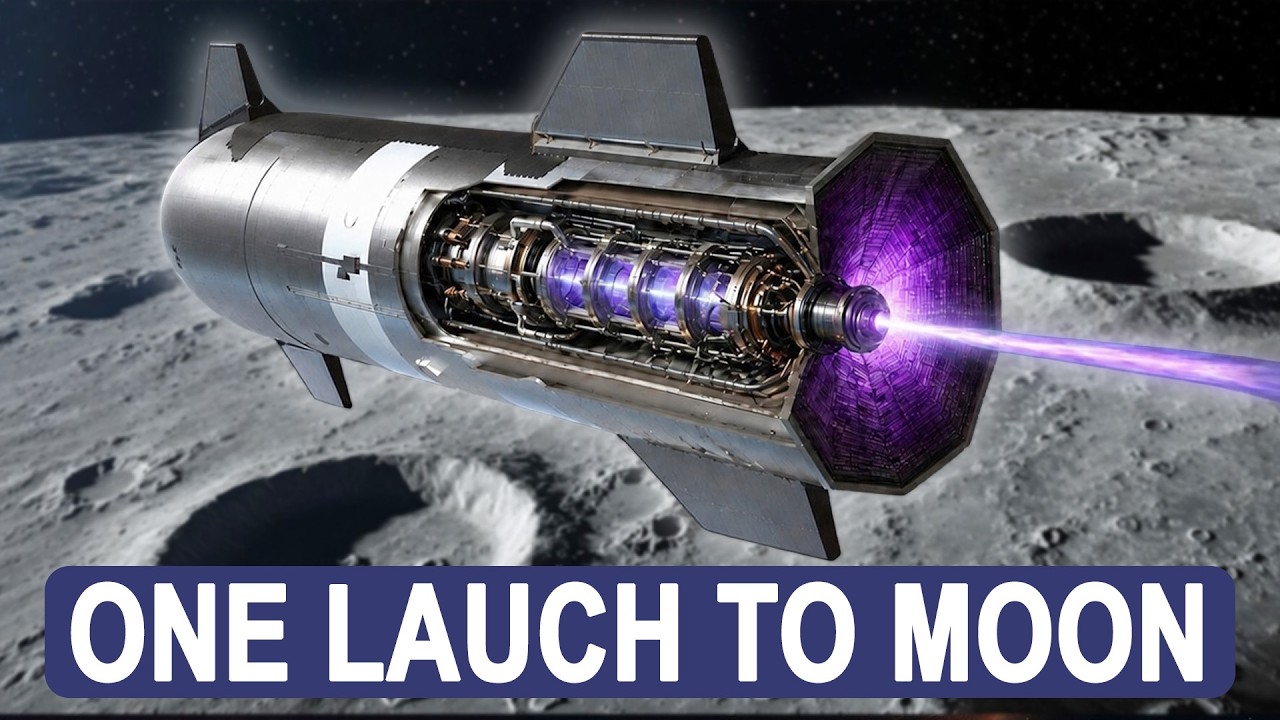
SpaceX’s new Method to Launch Starship to the Moon Without Refuelling!
===
#techmap #techmaps #elonmusk #starshipspacex
===
Intro 0:00
Why Nuclear Thermal Propulsion? 1:00
How to make it work for Starship? 5:45
Challenges 13:01
===
Sources:
iamVisual:
Tweets by visual_iam
https://www.youtube.com/@iamVisualVFX/videos
Kimi Talvitie: https://twitter.com/kimitalvitie
https://www.youtube.com/@kimitalvitie/videos
TijnM : https://twitter.com/m_tijn
https://www.youtube.com/channel/UCDA8yz_nQY-0Uxd96-qxYjA
Evan Karen: https://www.youtube.com/channel/UCDN1X8Fz1oAXX-rBcOWjzmg
Matthew Ryan:
https://www.youtube.com/channel/UC0oP_hNkRB1ix63bDIhzi2A
Matthew Cable: https://www.youtube.com/channel/UCE7qCXj0i-RYb_UY2mMvBoQ
Truthful: https://x.com/Truthful_ast
Erc X: https://twitter.com/ErcXspace
ErcX Space https://www.youtube.com/c/ErcXSpace/
Christian Debney: https://twitter.com/ChristianDebney
https://www.youtube.com/@christiandebney1989
C-bass Productions: https://www.youtube.com/c/CbassProductions
DeepSpaceCourier
https://www.youtube.com/@deepspacecourier/videos
the lonely cat: https://www.youtube.com/@thelonelycatproject
proxidesuwa
https://x.com/pr0ximacentaura
PROXI Ch.2426 △
https://www.youtube.com/@Proxima_Channel.2426/videos
Alexander Svan: https://twitter.com/AlexSvanArt
https://www.youtube.com/channel/UCFtAc_KRuj4mrr0bVMZMn2w
===
SpaceX’s new Method to Launch Starship to the Moon Without Refuelling!
Nuclear Starship could be the key to eliminating orbital refueling—a major bottleneck in deep-space missions. Could a nuclear-powered SpaceX Starship really fly to the Moon and return without tanker support?
In this video, we explore how Nuclear Thermal Propulsion could fundamentally change Starship’s architecture. Instead of relying on multiple launches to refuel in orbit, a nuclear-enabled system could achieve higher efficiency, greater delta-V, and simplified mission profiles. We break down how this concept works, why methane may be the optimal propellant choice, and what engineering changes would be required to safely integrate a nuclear reactor into Starship.
You’ll also get a balanced look at the trade-offs—because while nuclear propulsion offers major advantages, it introduces serious challenges in safety, reusability, and cost.
SpaceX’s new Method to Launch Starship to the Moon Without Refuelling!
As you know, with its current design, SpaceX Starship can’t reach the Moon without a chain of refueling launches.
Right now, every deep-space mission depends on a complex orbital ballet—launch, dock, transfer fuel, and repeat. Over and over again. It’s expensive, fragile, and never proven at this scale.
Now imagine removing all of it. No orbital tankers. No refueling choreography. Just one launch, and a direct flight to the Moon.
It sounds impossible—because with chemical rockets, it is. Unless you change the engine itself.
In this video, we’re exploring one of the most radical ideas ever proposed: a nuclear-powered Starship that could fly to the Moon, land, and return, without refueling at all.
And if this works, it doesn’t just simplify missions—it changes the future of space travel.
SpaceX’s new Method to Launch Starship to the Moon Without Refuelling!
Why Nuclear Thermal Propulsion?
Although today’s chemical rockets represent the cutting edge of modern engineering, they are starting to brush up against hard physical limits. Engines like the Raptor engine rely on burning fuel and oxidizer, and that process—while incredibly powerful—is fundamentally constrained by chemistry. You can only extract so much energy from combustion, which caps how efficient these engines can become.
One way to see that limit clearly is through specific impulse, the key measure of propulsion efficiency. In simple terms, higher specific impulse means you get more thrust per unit of propellant. Vacuum-optimized Raptors reach around 380 seconds, which is already exceptional for chemical propulsion. But nuclear systems operate in a completely different regime. Using Nuclear Thermal Propulsion, a reactor heats propellant, for example, hydrogen, directly instead of burning it—unlocking efficiencies of 900 seconds or more. That’s not a small improvement; it’s a leap.
This gap explains why chemical missions become so complex. A fully fueled SpaceX Starship heading beyond Earth orbit may need 10–12 tanker launches just to fill up in space. Every extra launch adds cost, coordination, and risk. And because chemical propulsion is less efficient, missions also take longer, increasing astronaut exposure to cosmic radiation and the stresses of deep space.
===
Subcribe TechMap: http://tinyurl.com/3z5ysrtf