





A major U.S. police organization has endorsed the latest CLARITY Act draft, but unresolved disputes over political ethics, DeFi protections and stablecoin rewards continue to threaten its passage before the Senate recess.
Summary
- Major Cities Chiefs Association endorsed the CLARITY Act after lawmakers added new enforcement provisions.
- Polymarket traders place the bill’s chance of becoming law in 2026 at 30%.
- Democrats and prosecutors continue to seek changes to the bill’s DeFi developer protections.
- Banks support federal crypto rules but want tighter restrictions on stablecoin rewards and yield.
Major Cities Chiefs Association backs CLARITY Act
The Major Cities Chiefs Association endorsed the latest version of the CLARITY Act in a letter to Senate Banking Committee Chair Tim Scott and ranking member Elizabeth Warren.
MCCA said recent revisions addressed concerns previously raised by police and prosecutors. The organization specifically pointed to additional law-enforcement provisions and the inclusion of state and local agencies in Sections 10203, 10204 and 10309.
“The inclusion of these provisions represents a meaningful step toward improving the ability of law enforcement to investigate financial crimes involving digital assets,” the association wrote.
MCCA joins several other police organizations that have moved toward supporting the proposed U.S. crypto market structure framework.
The National Organization of Black Law Enforcement Executives became the first major police association to endorse the bill. The Federal Law Enforcement Officers Association later offered conditional support while requesting stronger rules governing accountability in decentralized finance.
The National Fraternal Order of Police, which represents more than 382,000 officers, also reversed its previous opposition after reviewing revisions to the Blockchain Regulatory Certainty Act provisions.
Major County Sheriffs of America has stopped short of endorsing the legislation but withdrew its formal opposition. The group adopted a neutral position while asking Congress to give state and local agencies a role in Treasury studies and advisory panels created under the bill.
Why police groups previously opposed the crypto bill
Earlier law-enforcement resistance focused primarily on the CLARITY Act’s treatment of non-custodial crypto developers.
The Blockchain Regulatory Certainty Act language generally protects developers and infrastructure providers from being classified as money transmitters when they do not control customer funds. Supporters say those protections prevent programmers from being prosecuted solely because criminals use open-source software.
Police groups and prosecutors argued that earlier wording was too broad. They warned that DeFi operators, mixers and other services could use the exemption to avoid registration and accountability, making it harder to trace illicit funds or recover assets for victims.
Revisions clarified that developers may still face prosecution when they knowingly or intentionally facilitate money laundering and other crimes. The updated draft also preserves existing criminal-enforcement powers and gives state and local agencies a larger role.
However, Democrats led by Senator Catherine Cortez Masto and several prosecutors continue to seek additional changes. Their proposal would narrow or remove protections that could shield some crypto service providers from prosecution.
Banks push for tighter stablecoin restrictions
The banking industry supports the broader goal of establishing federal rules for digital assets but wants lawmakers to revise the bill’s stablecoin provisions.
A coalition of 134 banking association officials and senior bank executives has asked the Senate to strengthen Section 10404. That provision restricts stablecoin issuers from paying interest but allows certain rewards tied to payments, memberships and other activities.
Banks argue that exchanges could use those exceptions to provide returns resembling interest on stablecoin balances. They warn that such products could pull deposits away from regulated banks and reduce funding available for mortgages, agricultural credit and small-business loans.
The American Bankers Association and five other financial trade groups have called the legislation an important step toward federal crypto regulation. However, they want Congress to prohibit passive returns tied to the size or duration of stablecoin holdings while preserving legitimate transaction-based rewards.
White House crypto adviser Patrick Witt has disputed the banking industry’s warnings, arguing that banks are seeking protection from competition rather than stronger consumer safeguards.
Ethics dispute leaves passage odds at 30%
Despite growing police support, political ethics remains one of the largest barriers to a Senate agreement.
Democrats want restrictions addressing financial interests in crypto held by elected officials and their families. Republican Senator Thom Tillis has also indicated that he will not support the bill without an acceptable ethics provision.
Tillis reportedly plans to send a bipartisan ethics proposal to the White House for President Donald Trump’s approval. Democrats have not ruled out supporting a vote before the recess, but they are unlikely to back the current text without further changes.
Polymarket traders place the probability of Trump signing the CLARITY Act in 2026 at 30%. The Senate has until its scheduled Aug. 7 recess to reach an agreement and advance the legislation during the current window.
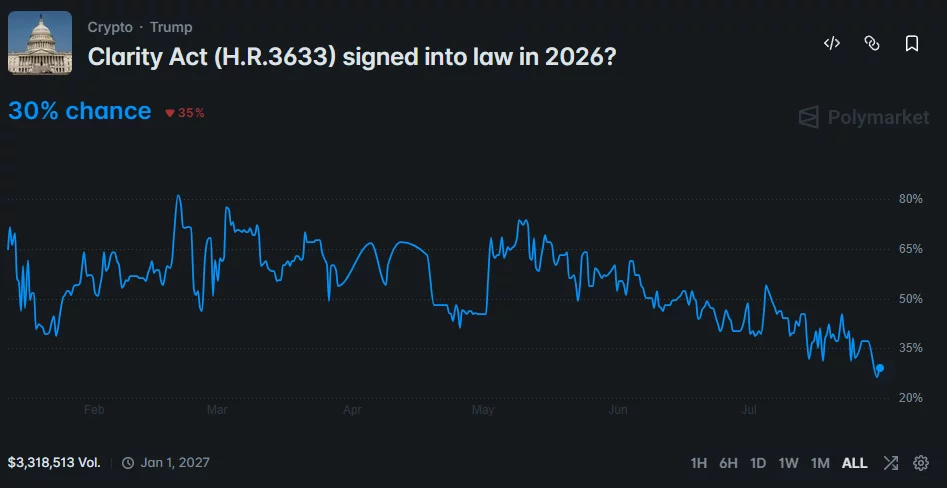
MCCA’s endorsement removes one source of institutional resistance, but it does not resolve the ethics, DeFi and stablecoin disputes. Without a bipartisan compromise, the bill may struggle to secure the 60 Senate votes needed to overcome a filibuster.