





Robinhood Chain surge boosts ETH price
The successful launch of the layer-2 network Robinhood Chain has boosted investor sentiment around Ethereum. The newly launched blockchain uses ETH as its native gas token and around $141 million in ETH has already been bridged to the chain.
More than half a million wallets holding ETH are now on the network, which surged past the Ethereum L1 and rival L2 Base over the past 24 hours, with DEX volumes of $877.56 million. The L2 is an offshoot of TradFi trading platform Robinhood, which offers tokenized stocks to customers in 120 countries, further strengthening the EVM-compatible ecosystem.
L2s have been seen by many pundits as bearish for Ethereum as they take activity away from the L1 without returning much in the way of transaction fees. However even some former ETH bears are now reassessing that thesis. Influencer Ansem wrote:
“lighter and robinhood L2s are sneakily best setup for an eth bull thesis in a very long time.”
Mike Dudas from 6th Man Ventures added that “robinhood chain is the single most bullish thing i’ve seen in eth-land in years.”
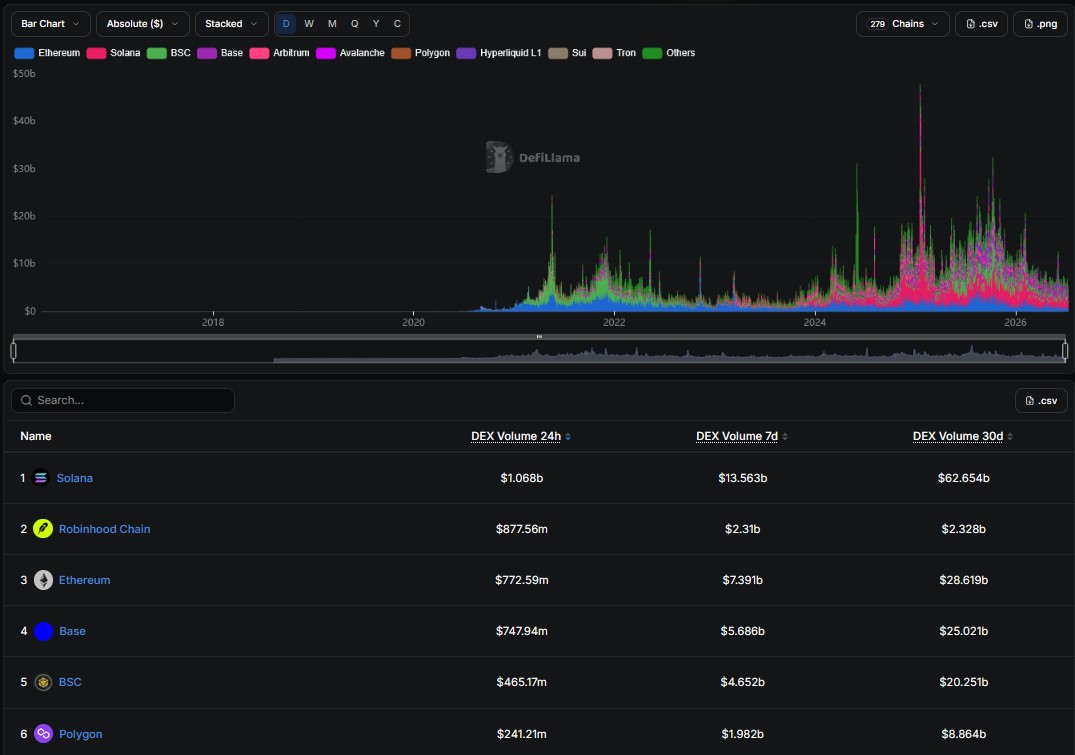
Robinhood surges in 24 hour DEX volume (DeFi Llama)
Ethereum is also getting a boost from its 47% market share of Real World Assets, according to Rwa.xyz data. Leon Waidmann, head of Research at Lisk, noted the Total Value Locked (TVL) on Ethereum of $260 billion has surpassed the $210 billion market cap of Ether. Waidmann said this distortion signals that “ETH is underpriced,” as the current relative valuation is lower than in the 2022 bear market.
UK politicians mull permanent crypto donation ban in wake of Nigel Farage scandal
Members of the UK’s ruling Labour party are considering a total ban on digital asset donations in response to Nigel Farage’s resignation from Parliament and the potential influence crypto billionaires had on his policies.
The Guardian reported Thursday that Labour MPs have proposed that a moratorium on crypto donations enacted in March be made permanent after it was revealed that the Reform leader personally accepted millions of British pounds in what he called “gifts” from industry figures.
Farage sensationally resigned from Parliament last week in an attempt to get ahead of an investigation into the donations by the UK’s parliamentary standards commissioner.
“Let me be absolutely clear: I have done nothing wrong,” said Farage in an X livestream. “I have not broken the law in any way at all. I have not misused public money.”
The major parties are refusing to field candidates against him in the upcoming by-election, with his most formidable political opponent the comedy character Count Binface, who has received support from Reform’s critics.

US Bitcoin reserve hits snag as federal agencies debate for control: Bloomberg
The Trump administration’s push to establish a US Strategic Bitcoin Reserve has reportedly hit a roadblock, as the Commerce and Treasury departments are at odds over how the reserve should be structured and which agency should have primary oversight of the holdings.
US President Donald Trump’s March 2025 executive order called for the SBR to be housed inside the Treasury Department, while other agencies would assist with asset seizures to build the reserve.
However, concerns have emerged over whether the Treasury has the legal authority to manage the Bitcoin (BTC) holdings, partly because of its volatility, Bloomberg reported Monday, citing people familiar with the matter.
The Commerce Department has emerged as a contender to oversee the reserve, the sources said. The Department of Justice is also reportedly working with the departments to determine legally available options, they added.
Wyden urges Senate leaders to keep dev protections in crypto bill
US Democratic Senator Ron Wyden has urged Senate leaders to ensure that crypto developer protections stay in the crypto market structure legislation.
Wyden told Senate Minority Leader John Thune and Senate Majority Leader Charles Schumer in a letter to preserve a section of the CLARITY Act known as the Blockchain Regulatory Certainty Act (BRCA).
“Developers who make and release software that allows people to manage their own digital assets — and, critically, where the developer does not control user assets — should not be treated as money transmitters solely because they create or publish software,” Wyden wrote.
The letter comes after certain groups and lawmakers opposed the BRCA. A group of law enforcement organizations and a coalition of Catholic organizations last month argued it could create gaps in the oversight of illicit activity.
Senate leaders are pushing for the bill to be passed this month.

Trump says he became ‘a big crypto guy’ partly for politics
US President Donald Trump says he got involved in crypto “for politics” and became pro-crypto after seeing how much money the industry was making.
At a press conference in the Oval Office on Monday to announce “Trump Accounts,” an investment account for children under 18, Trump was asked whether the accounts would allow for Bitcoin (BTC).
“I’ve become a big crypto guy only for one reason: If we don’t have it, China’s going to have it,” Trump answered. “I’m a fan, I wasn’t initially, I didn’t know much about it, but, for some of my first term, I wasn’t much involved, and I watched it grow, and it’s a huge industry.”
“I got involved in it a little bit for politics,” Trump added. “I realized there are a lot of people that love crypto.”
In his first term, Trump said he was “not a fan” of crypto and called Bitcoin “a scam.” Since then, he and his family have built deep business interests in crypto, and Trump has faced criticism for his pro-crypto stance and for making more money out of crypto in 2025 than any of the listed exchanges or miners.
Five senators have called for committee hearings to investigate Trump’s policies potentially being influenced by crypto funding from United Arab Emirates-linked and other entities.

Winners and Losers
At the end of the week, Bitcoin (BTC) is at $63,762, Ether (ETH) at $1800 and XRP (XRP) is at $1.08. The total market cap is at $2.2 trillion according to CoinMarketCap.
Among the biggest 100 cryptocurrencies, the top three altcoin winners of the week are DeXe (DEXE) with a 94% gain, Pyth Network (PYTH) at 19%%, and Arbitrum (ARB) at 15%.
The top three altcoin losers of the week are Bonk (BONK) which lost 19%, Jupiter (JUP) on -18% and Pi (PI) at -16%.
Top Prediction of the Week
Bitcoin nearing late stages of bear market: Jamie Coutts, Real Vision
Bitcoin could be entering the latter stages of the bear market, with downside momentum beginning to slow down, according to Real Vision chief crypto analyst Jamie Coutts.
“I think we’re getting through most of the bear market action. It’s still not over, clearly. But you know, I think we’re approaching at least the second half,” Coutts said during an interview on Cointelegraph’s Trade Secrets.
He noted that Bitcoin’s volatility has declined by about 50% compared with the previous market cycle, suggesting the current downturn may be less severe than previous bear markets.
Coutts added that he’s not comfortable making predictions for a $1 million Bitcoin price in 2030 due to too many variables. However he said:
“I’m more comfortable with a forecast in the next sort of two to three years that Bitcoin should get to sort of $200,000 to 250,000.”
Top FUD of the Week
Strategy’s Saylor needs clarity in BTC pivot message to convince investors
Standard Charter’s global head of digital assets research, Geoff Kendrick, believes recent Strategy sale of $216 million worth of Bitcoin to pay for STRC dividends — and Michael Saylor’s manner of communicating decisions — “are muddying the waters for BTC near-term.”
“We think effective communication of MSTR’s new strategy (using BTC to back STRC) is key to reassuring markets that wholesale selling is unlikely; this should in turn support BTC prices,” Kendrick wrote in a note to clients on Friday. “Indeed, if this signalling proves effective, it should remove the need for MSTR to actually sell any BTC by supporting STRC’s price,” he said.
Kendrick said that Strategy’s long-held “never sell” approach had limited what the company could with its industry-biggest digital asset treasury.
“The problem with the ‘never sell’ approach is that it limits what MSTR’s BTC holdings can do — or, perhaps more importantly, what they are perceived to be doing,” the StanChart analyst said.
Kalshi appeals NY court’s rejection of bid to block state gambling law enforcement
Kalshi is appealing a New York federal judge’s rejection of its bid to block officials at the New York State Gaming Commission from enforcing local laws against its sports-related event contracts.
The appeal escalates a growing legal fight over whether sports prediction markets are federally regulated derivatives or state-regulated gambling products. This question has already split courts across the United States.
Judge Analisa Torres rejected that argument and found that New York gambling laws, as applied to Kalshi’s sports-event contracts, were not preempted by the US Commodity Exchange Act. The court said Kalshi had not made a “clear or substantial showing” that it was likely to succeed on the merits.
“Major loss for Kalshi in the nation’s financial capital, with likely knock-on effects in other cases (esp. Connecticut and other SDNY lawsuits),” wrote lawyer Daniel Wallach.
Trader loses $1M after signing phishing token approval
A crypto user lost nearly $1 million on Wednesday after signing a phishing token approval on Ethereum, according to onchain data.
A Scam Sniffer alert on Thursday revealed a victim lost 999,999 USDt (USDT) to an Ethereum phishing token approval scam. Scammers first tried draining a rounded $1 million via multicalls but failed due to insufficient funds, then succeeded seconds later by pulling the exact balance in follow-up transfers.
“The script recalculated and pulled the exact remaining balance,” Scam Sniffer said.
Social engineering via phishing token approvals has become a common crypto scam tactic. Phishing losses totaled $723 million across 248 incidents in 2025, according to CertiK. Scammers trick a victim into giving a malicious actor access to their wallet, taking the form of an innocuous-seeming transaction.
The victim falsely believes that clicking “approve” will only initiate a minor task, but malicious links give the attacker approval to drain funds from the wallet.