
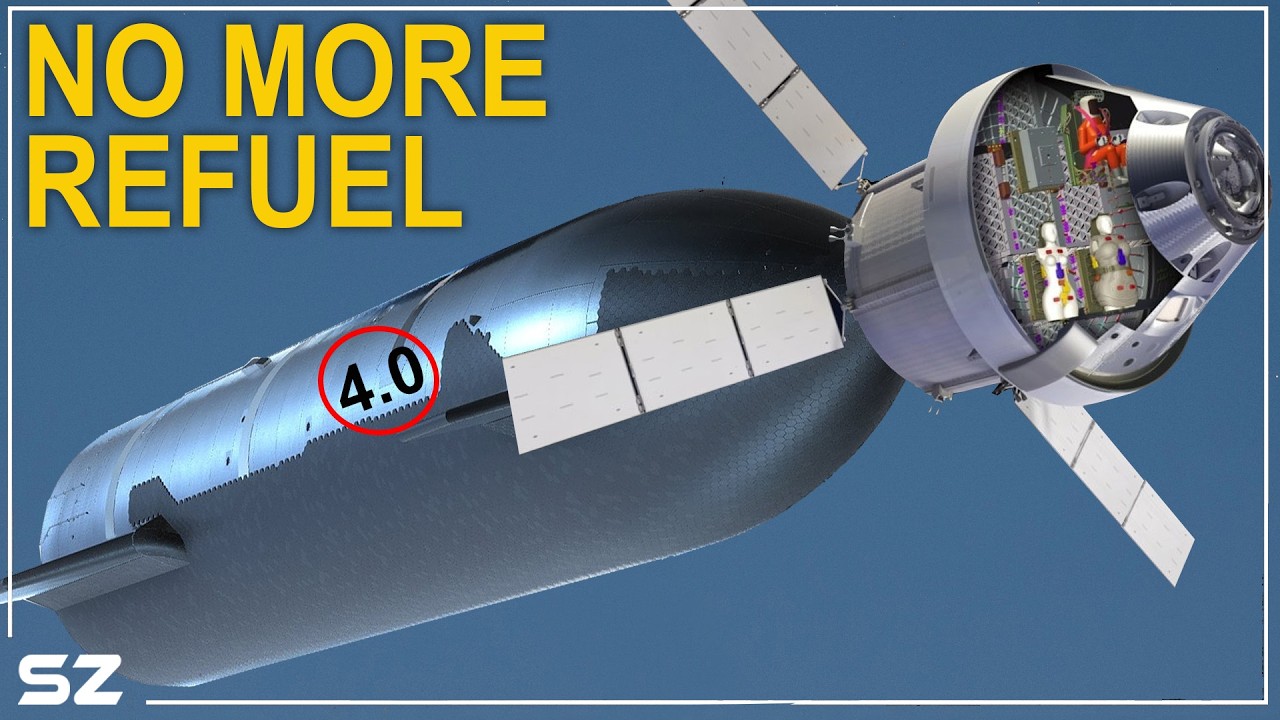
SpaceX’s new Starship Option to send NASA Orion Straight to the Moon! Better than SLS…
===
#spacezone #spacex #starship #
===
Intro: 0:00
Let’s look at the delta-v: 0:30
Some other engineering issues: 5:53
Replaces the SLS with Starship: 7:28
===
SpaceX new Starship Option to send NASA Orion to the moon
We would like to extend our special thanks to:
Evan Karen: https://www.youtube.com/@EvanKaren
TijnM: https://www.youtube.com/@tijn_m
Tony Bela : https://x.com/InfographicTony
Truthful: https://x.com/Truthful_ast
SLS: https://x.com/ScottLikedSLS
velin3d: https://www.youtube.com/c/velin3d/
Erc X: https://x.com/ErcXspace
Dale Rutherford: https://twitter.com/Dtrford
===
SpaceX’s new Starship Option to send NASA Orion Straight to the Moon! Better than SLS…
You’ve probably heard the news that NASA is proposing a new lunar plan that leans much more on Starship to land humans on the Moon. But what hasn’t really been talked about much yet is how this would actually work in detail.
So today, we’re going to break that down. What would this new mission architecture actually look like? Can Starship realistically handle all of that responsibility? And finally, the big question—could Space Launch System be replaced completely, with Starship taking over most parts of the mission?
SpaceX’s new Starship Option to send NASA Orion Straight to the Moon! Better than SLS…
Let’s look at the delta-v:
Under this new proposal, the Space Launch System wouldn’t be the one sending Orion all the way to lunar orbit anymore. Instead, Orion would meet up with Starship in Earth orbit, dock there, and then Starship would take over—pushing the whole stack toward the Moon and eventually handling the trip down to the surface.
At first glance, that sounds like a bigger job for Starship… and yeah, in some ways it is. But there’s also a trade-off that actually makes things a bit easier. In the original plan, Starship would refuel in Earth orbit, head out to lunar orbit, and then just sit there waiting for Orion to show up. And that waiting period could stretch up to about three months. That’s a long time to keep all that propellant stable, especially when you have to worry about boiloff, which means you’d likely need to leave Earth orbit with completely full tanks just to stay safe.
SpaceX’s new Starship Option to send NASA Orion Straight to the Moon! Better than SLS…
With this new approach, that whole “waiting in lunar orbit” problem basically disappears. Since Starship stays in Earth orbit instead, Orion doesn’t have to hit super-tight launch windows anymore. It could launch on a much more flexible schedule, dock with Starship pretty quickly, and head out together. So Starship spends way less time just hanging around, which takes a lot of pressure off the propellant management side.
Now, the real question is whether Starship can actually handle the mission. For this, we got to look at the delta-v, which is basically the total “budget” a spacecraft has to perform all its maneuvers, from leaving Earth orbit to landing on the Moon and coming back up.
 Bitcoin(BTC)$81,603.00-0.68%
 Ethereum(ETH)$2,432.30-0.81%
 Tether(USDT)$1.00-0.03%
 BNB(BNB)$721.22-1.28%
 XRP(XRP)$1.31-2.30%
 USDC(USDC)$1.00-0.03%
 Solana(SOL)$104.95-1.28%
 TRON(TRX)$0.3354320.40%
 Figure Heloc(FIGR_HELOC)$1.030.29%
 Zcash(ZEC)$1,170.44-4.53%
Related Posts
Add A Comment