





Tokenomics is the economic design of a crypto token: how it is created, distributed, used, and removed from circulation, and what makes anyone want to hold it. The word is just “token” plus “economics.” Get it right and the token works for the business behind it. Get it wrong and people sell the moment they can.
Tokenomics, defined
Tokenomics is the full set of rules that run a token’s economy. Total supply, how tokens are split between groups, when they unlock, what holders can do with them, and what pulls them back out of circulation.
All of it points at one question: can demand keep up with supply as the project grows. Most of the time, it can’t, and that gap is where the price goes to die.
A token is more than a tradable asset. It’s an incentive system designed to shape the behavior of users, investors, validators, and developers. Good tokenomics aligns those incentives so every participant benefits from the network becoming more useful over time.
What does tokenomics mean?
It means the economics of one specific token. A supply side, which is issuance, allocation, vesting, and inflation. And a demand side, which is utility, incentives, and every reason a person holds instead of sells.
Unlike traditional company economics, tokenomics is often transparent from day one. Supply schedules, unlock calendars, and treasury allocations are published publicly, giving investors far more visibility into future dilution than they typically get in traditional markets.
Why tokenomics decides if a project survives
Because you set it before launch, write it into smart contracts, and then you’re mostly stuck with it.
A model that rewards quick flipping falls apart no matter how good the product is. A model that rewards real usage builds demand that outlasts the hype. One shot, and the stakes are higher than most founders treat them.
The core components of tokenomics
Almost every token model is built from the same parts. Learn these six and you can read pretty much any crypto economy, whether it’s a billion-dollar protocol or something that launched last Tuesday.
Each component affects the others. Changing emissions, for example, influences staking rewards, circulating supply, and ultimately investor behavior. Looking at any single metric in isolation rarely tells the full story.
What are the main components of tokenomics?
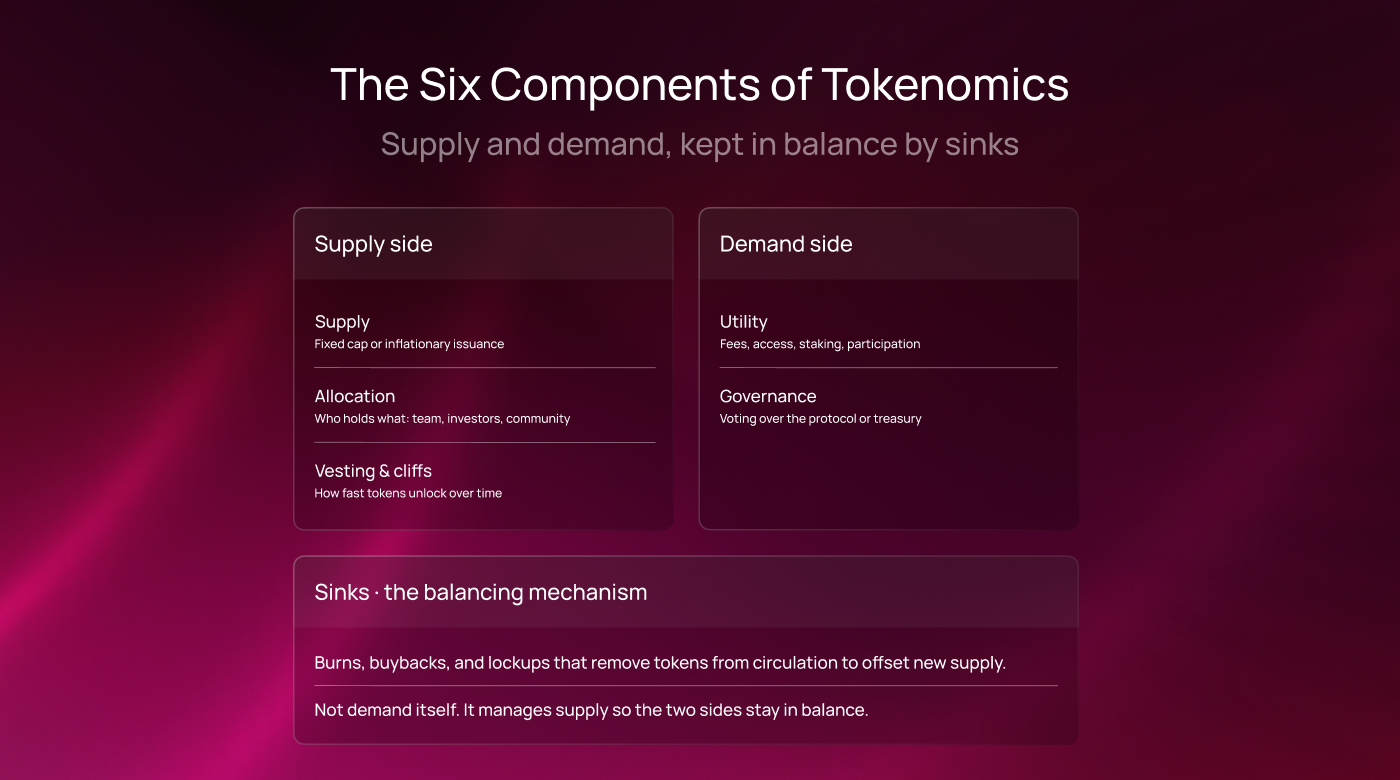
Six parts do most of the work, and they split into two camps: supply and demand.
The supply side is how many tokens exist and how they reach people. Supply can be fixed, like Bitcoin’s 21 million cap, or inflationary, with new tokens issued on a schedule. Allocation then splits that supply between the team, investors, the community, the treasury, and liquidity, which is how you see who holds what. Timing is the last piece. A cliff delays the first unlock completely, and vesting drips the rest out over months, sometimes years.
The demand side is the reason anyone holds at all. Utility sits at the center of it: paying fees, accessing a service, staking, voting. No utility, no real demand. Sinks work the other way, pulling tokens back out of circulation to offset new supply through fee burns, staking locks, or buybacks. Governance is the last component, deciding whether the token gives holders a say over a protocol or its treasury, the model behind a Decentralized Autonomous Organization (DAO).
Get these parts working together and they hold each other up. Get one badly wrong, usually utility or vesting, and the rest can’t save it.
How token supply, allocation, and vesting work
These three move as one system. A project sets a total supply, splits it among groups, then releases each share on a schedule meant to avoid a wall of sell pressure all at once.
The distribution itself also sends a signal. A large community allocation suggests long-term ecosystem growth, while oversized insider allocations can raise questions about governance, decentralization, and future selling pressure.
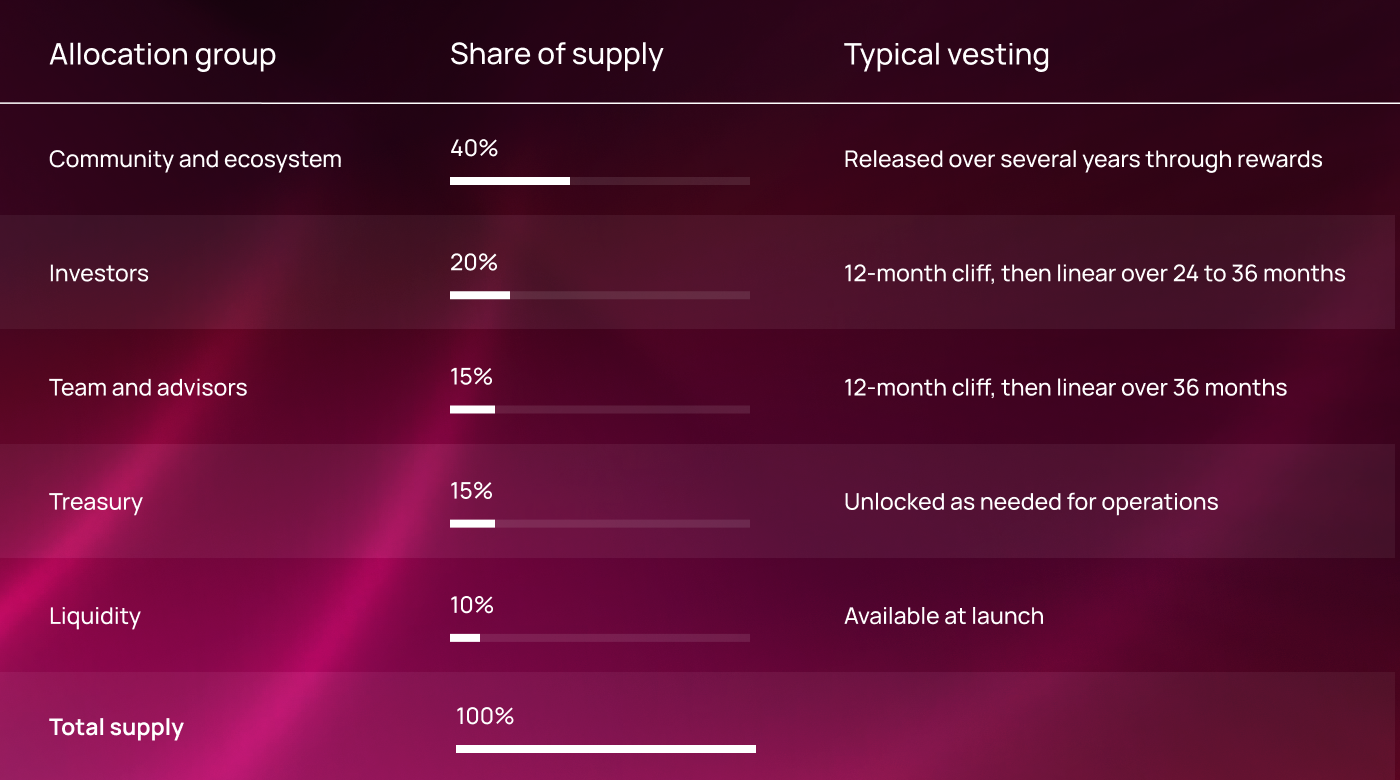
Illustrative numbers, not advice. Real allocations move around with the project, the sector, and the stage it launches at.
How does token vesting work?
Vesting lets tokens out slowly so nobody can dump their whole stack on day one. A common shape: a 12-month cliff with nothing unlocking, then linear monthly releases over the next two to three years. When a team and its investors accept long vesting, that tells you something. It also protects the token in the fragile stretch right after the Token Generation Event (TGE), which is exactly when it’s easiest to break.
Every major unlock is effectively a supply event. Markets often price these in ahead of time, especially if the project hasn’t yet generated enough real demand to absorb the additional circulating supply.
What makes tokenomics sustainable
Sustainable tokenomics ties the token to the business it belongs to. Value comes in from real product usage. Demand climbs as the product grows. Fees, staking, and burns keep circulation in check. A token that grows with the business, instead of one that needs constant hype just to hold its price.
This is the idea behind a closed economic loop, the approach at the core of how firms like 8Blocks design token economies. Product usage drives token demand, controlled circulation manages supply, and value flows back into the system. Build it that way and the token becomes part of the business instead of a chip on a table. Treat it as an isolated bet, and it’s usually the first thing to break. The pattern shows up again and again: a short cliff lets early holders exit fast, the price drops, and the projects with no real utility underneath have nothing to catch the fall.
The strongest token models don’t force demand – they create it naturally. As more users rely on the product, demand for the token increases because the token serves an actual function rather than acting purely as a speculative asset. That’s a much healthier foundation than depending on constant new buyers to support the market.
What makes a token valuable?
A reason to hold it that has nothing to do with speculation.
Usually that’s utility. The token is needed to use a service, earns a share of fees, secures a network through staking, or carries real governance weight. Scarcity on its own does almost nothing. A capped supply nobody wants is still worth nothing.
Many successful networks combine several demand drivers instead of relying on just one. A token that powers transactions, secures the network through staking, and gives meaningful governance rights tends to have more resilient demand than one built around a single use case.
Is a token a security?
A utility token gives holders access to a product or service, not ownership in a company. That’s what separates it from a security token tied to equity or profit-sharing. Whether a specific token counts as a security comes down to how it’s structured and the jurisdiction it operates in, not what it’s labeled. Strong models are built to reduce the risk of security classification, but legal status is always decided case by case.
How to read a token model
New to this? Three questions. Where does demand come from, how fast does supply unlock, and who’s holding the biggest allocations. A project with real utility, gradual vesting, and a balanced split is in far better shape than one with vague utility, fast unlocks, and most of the supply sitting with insiders.
How do you analyze a project’s tokenomics?
Put the supply schedule next to the demand drivers and see which one wins. Check max and circulating supply, read the allocation, map the vesting so you know when the big unlocks land. Then the only question that matters: is the utility strong enough to soak up that new supply when it hits. A useful first check is the unlock calendar against the first year of real demand. If a large investor tranche unlocks before the product has users, that gap tends to show up in the price.
If unlocks keep outrunning real demand, the price is under pressure no community can fix.
Key takeaways
- Tokenomics is the economic design of a token: its supply, allocation, utility, and demand mechanics.
- The term joins “token” and “economics” and covers both how tokens are issued and why people hold them.
- The core components are supply, allocation, vesting, utility, demand sinks, and governance.
- Vesting and cliffs control how fast tokens hit the market and ease post-launch sell pressure.
- Sustainable tokenomics ties value to real product usage, so the token grows with the business.
- A utility token grants access rather than ownership, and legal classification depends on structure and jurisdiction.