





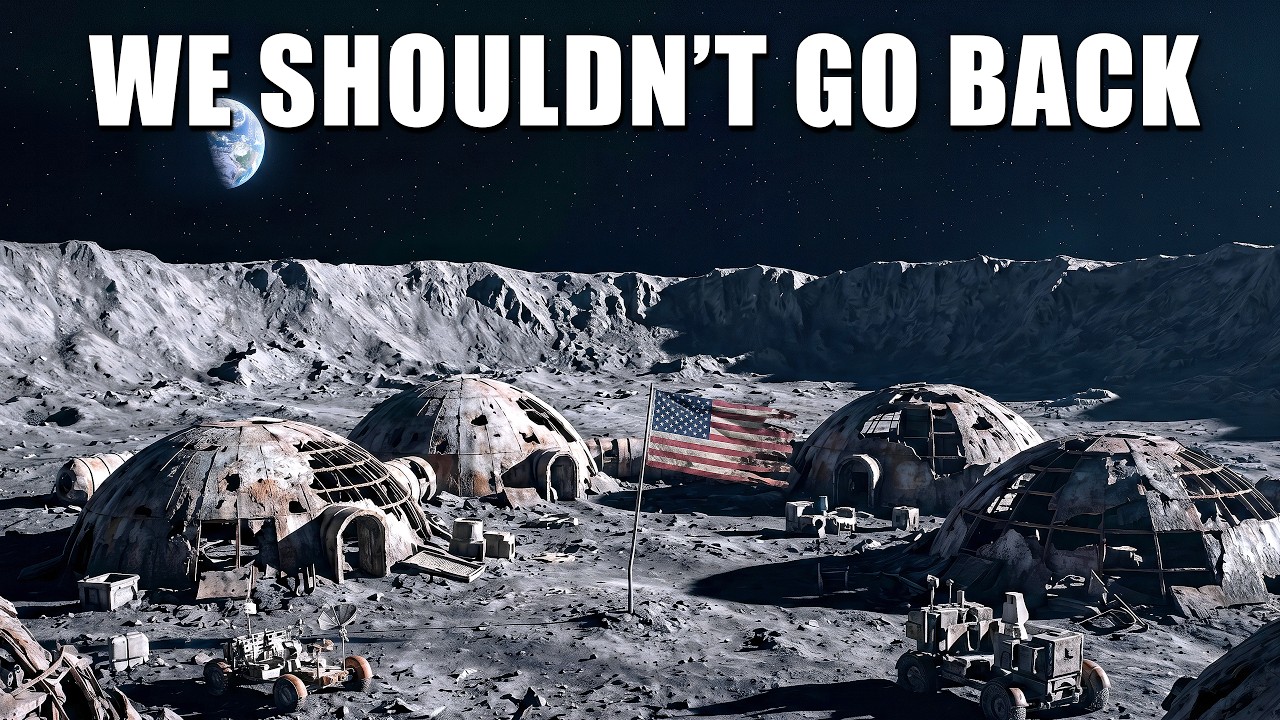
The Moon is only 384,000 km away. We just flew around it. But surviving on its surface is a completely different problem – and far harder than most people realize.
In this deep dive, we explore exactly what makes the lunar surface one of the most hostile environments in the inner solar system. Not vague dangers. Specific, concrete, physical realities that threaten every system humans would need to stay alive.
The temperature swings 300°C between day and night. Radiation bombards the surface at 200 times Earth’s dose rate – every single day. Lunar dust is so abrasive it wore through three layers of spacesuit material in under 24 hours during Apollo. Micrometeorites slam into every exposed surface at speeds up to 70 km/s with no atmosphere to stop them. And your own skeleton begins to weaken because one-sixth gravity is not enough to maintain it.
We break down vacuum exposure, thermal cycling, galactic cosmic rays, solar particle events, electrostatic dust contamination, hypervelocity bombardment, bone and muscle degradation under partial gravity, total life-support dependence, cascading system failures, and why every proposed solution – regolith shielding, lava tubes, 3D-printed habitats, nuclear power – remains unproven on the actual lunar surface.
With Artemis II returning and the first crewed landing targeted for 2028, this is the reality that every future Moon mission must confront. The Moon gives nothing for free. Everything required for survival must be built, powered, maintained, and defended, continuously, against an environment that never stops attacking.
This is not an argument against going. It is the precondition for going seriously.
Sources:
Zhang, S. et al. (2020). “First measurements of the radiation dose on the lunar surface.” Science Advances, 6(39), eaaz1334. https://www.science.org/doi/10.1126/sciadv.aaz1334
Yahalomi, D.A. et al. (2025). “Micrometeoroid Impact Rate Analysis for an Artemis-Era Lunar Base.” arXiv:2511.04740. https://arxiv.org/abs/2511.04740
Hayashi, T., Fujita, R., Okada, R. et al. (2023). “Lunar gravity prevents skeletal muscle atrophy but not myofiber type shift in mice.” Communications Biology, 6, 424. https://doi.org/10.1038/s42003-023-04769-3
Lam, C.W. et al. (2022). “Overview of lunar dust toxicity risk.” npj Microgravity, 8, 55. https://doi.org/10.1038/s41526-022-00244-1
Matthiä, D. & Berger, T. (2024). “Radiation Exposure and Shielding Effects on the Lunar Surface.” Space Weather, 22, e2024SW004095. https://doi.org/10.1029/2024SW004095
#MoonExploration #Artemis #LunarSurface #SpaceRadiation #LunarDust #NASAArtemis #SpaceScience