





By the end of 2025, the power capacity tied to artificial intelligence data centers worldwide had reached about 29.6 gigawatts (GW), enough to run all of New York state at peak demand, according to Stanford University’s annual report on the AI industry.
The report, released in April, suggests that compute itself is abundant and getting cheaper. Permitted, grid-connected, ready-to-draw electricity is in high demand, but the sources to power it are much harder to come by. One industry has spent the past decade quietly building exactly that infrastructure for a different reason: Bitcoin mining.

AI data center power capacity reached about 29.6 GW by the end of 2025, comparable to New York state at peak demand. Source: Stanford University
Chips get more efficient, but total demand rises
The economics of chips are moving in the opposite direction. Stanford said the cost of GPU computation has dropped more than 99% since 2006, while leading chips now perform far more work per watt than they did a decade ago. But efficiency gains have not reduced total demand. They are instead poured back into larger models rather than banked as savings, keeping the pressure on the power grid.
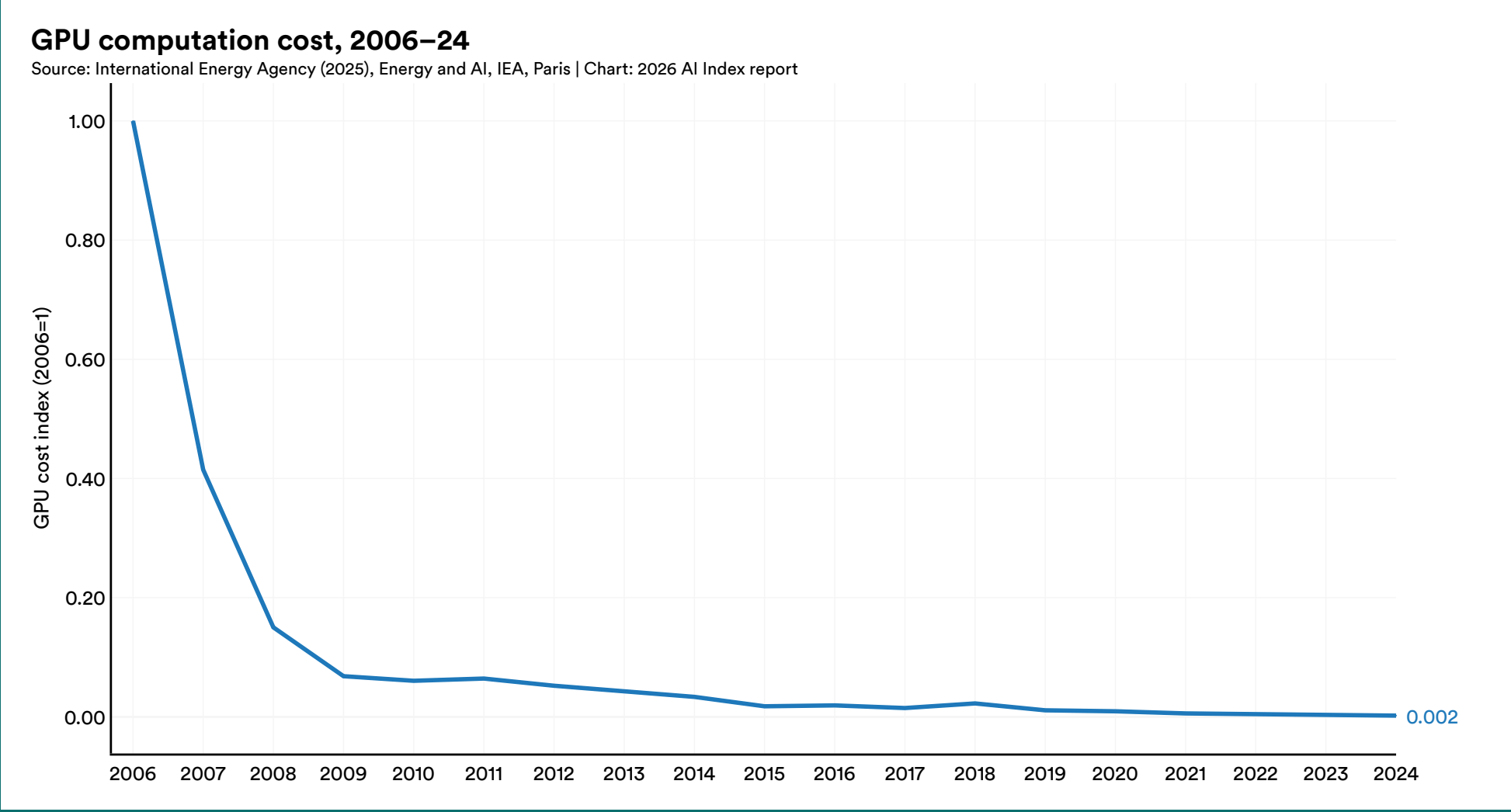
The cost of GPU computation has fallen more than 99% since 2006, even as total power draw climbed. Source: Stanford University
Stanford estimates that the most demanding training runs, including for systems such as Llama 4 Behemoth, have pulled upward of 100 megawatts (MW), comparable to a small power plant. Capacity dedicated to AI has risen some 200-fold in three years, from under a gigawatt in 2022, and data center electricity use is projected to keep rising through 2030.
The squeeze is geographic as much as numerical. The United States hosts 5,427 data centers, more than 10 times any other country, according to Stanford.
Chips can be ordered and delivered in months, but energizing a site, with its substation, interconnection approval and cooling, takes years.
Counted across full systems rather than the accelerators alone, AI’s cumulative power demand through 2024 reached an estimated 9.4 GW, close to the national electricity use of Switzerland or Austria and about half the estimated draw of Bitcoin mining.
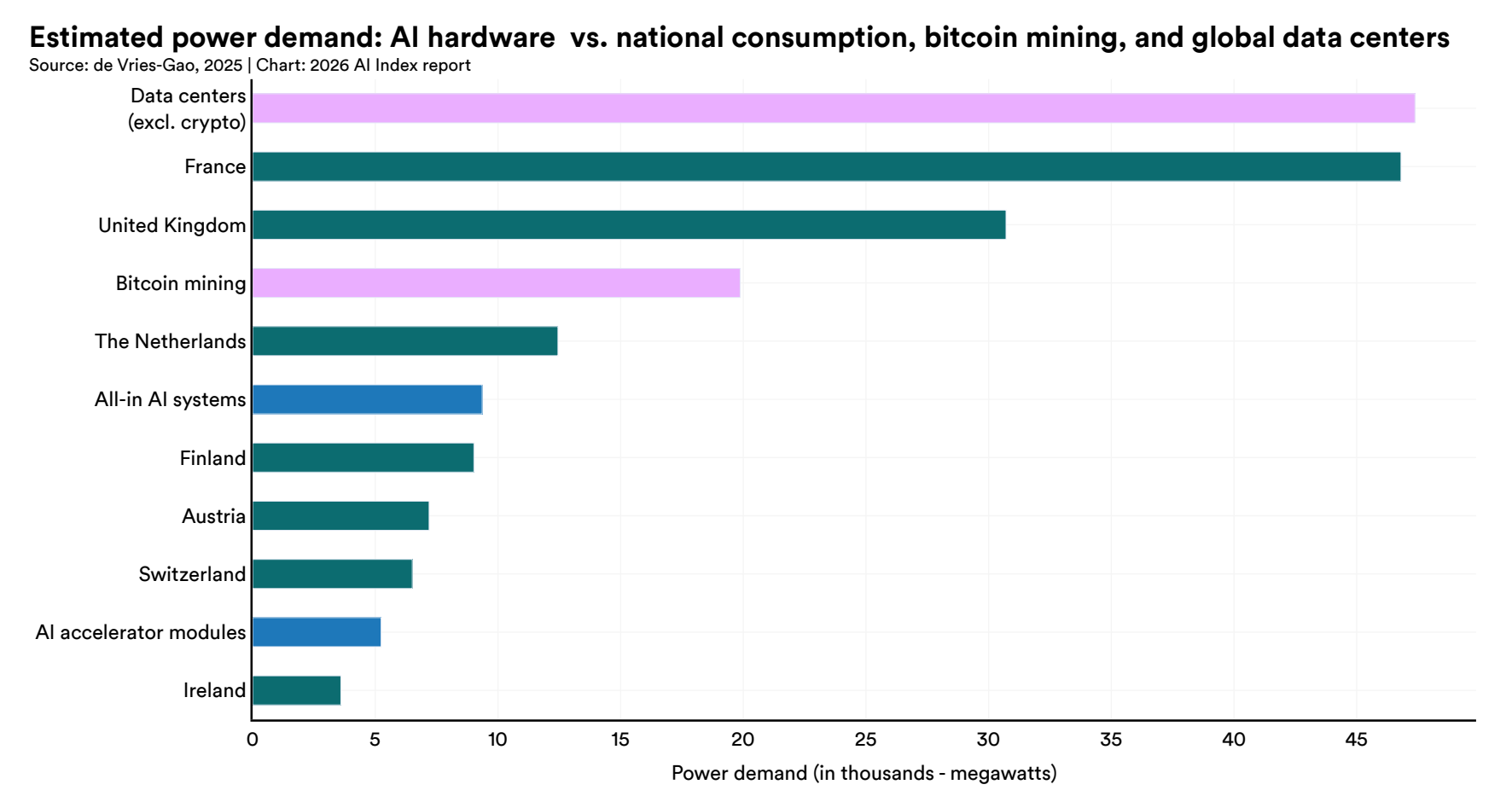
Estimated all-in AI power demand (through 2024) sits near half of Bitcoin mining’s. Source: de Vries-Gao, Stanford University
The asset was never the hardware
But Bitcoin miners cannot just hand their machines to an AI lab. Mining ASICs (the chips that solve Bitcoin calculations) do one narrow job and are useless for training or inference. What does transfer is everything around the chips, such as the energized sites, power contracts, grid hookups and the shells to cool dense racks.
A Bitcon miner that already has a grid connection has infrastructure ready to fill the gaps for the AI developers, and renting that capacity beats starting over. Miners also tend to sit where AI wants to be anyway, in cheap-power US states like Texas and the Gulf Coast.
Mining economics is itself a numbers-crunching game. JPMorgan recently estimated Bitcoin’s all-in production cost at about $78,000 per coin, well above BTC’s market price of around $53,400 at the time of writing, down by more than 34% year-to-date, according to CoinGecko.
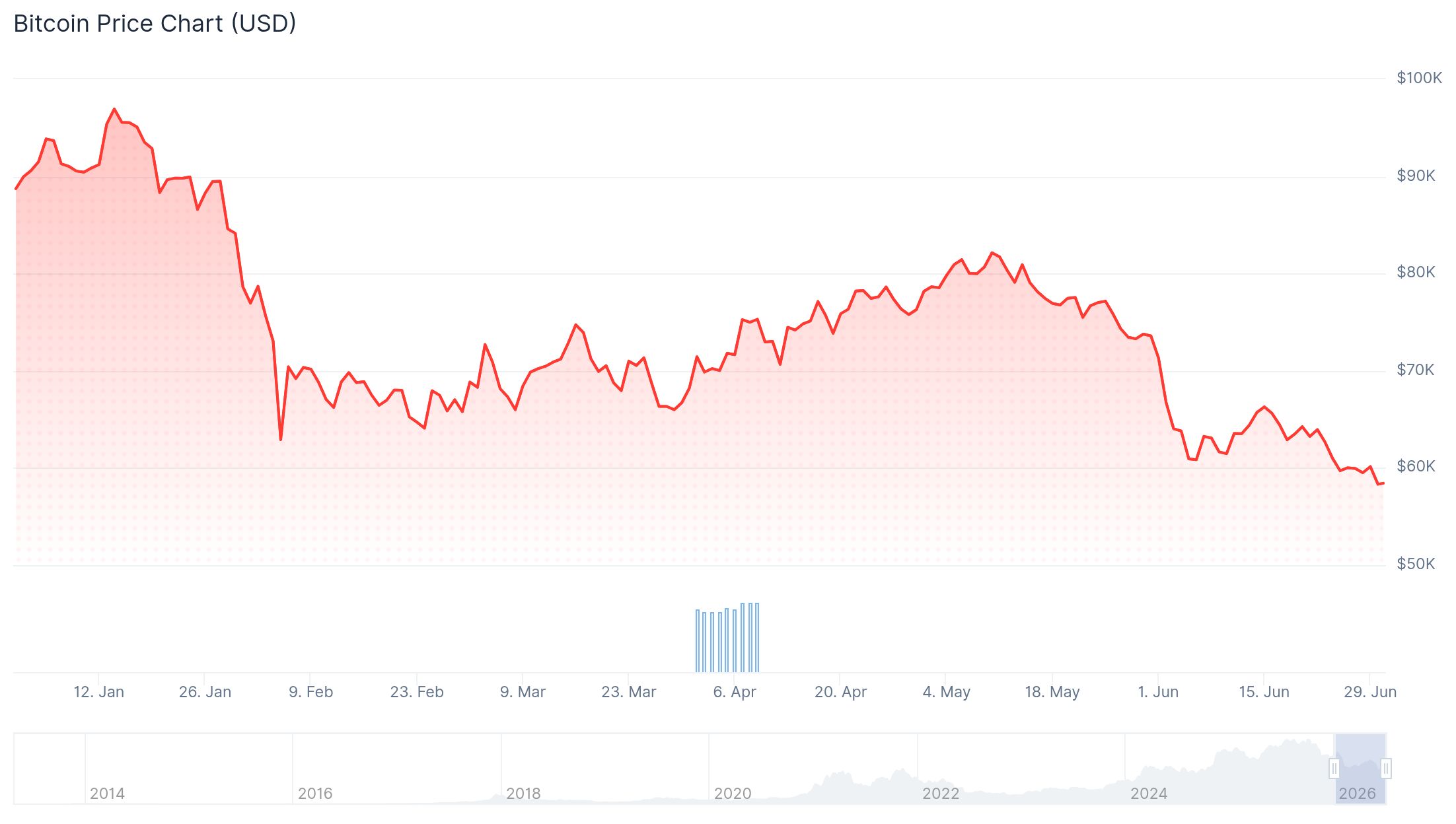
Bitcoin is down by around 34% in 2026. Source: CoinGecko
Cointelegraph previously reported that hashprice had fallen below breakeven for many miners, putting about 20% of the industry in unprofitable territory.
Some major contracts between miners and AI infrastructure operators followed. In November 2025, Iren signed a five-year GPU cloud deal with Microsoft worth about $9.7 billion, served from a 750-megawatt campus in Childress, Texas. In December, Bitcoin miner Hut 8 signed a 15-year, $7 billion lease with Fluidstack for 245 megawatts at its River Bend site in Louisiana, with the payments backstopped by Google.
TeraWulf reported $12.8 billion in contracted high-performance computing (HPC) revenue and now earns more from leasing than mining. Core Scientific has expanded its CoreWeave agreement to $10.2 billion over 12-year terms. Across the listed miner sector, CoinShares counts more than $70 billion in announced AI and HPC contracts, but much of the value is years out. Hut 8’s River Bend site, for example, is not due to start commissioning until the second quarter of 2027.
Related: TeraWulf doubles AI revenue but posts $427M quarterly loss as mining income declines
Investors have nonetheless rewarded the shift. Hut 8 stock jumped about 20% in premarket trading the day its lease was announced, Reuters reported, and across the sector, valuations are increasingly tied to compute pipelines rather than the Bitcoin price alone. Indeed, CoinShares said the miners with HPC contracts were trading at 12.3 times the value of their 12-month revenue vs 5.9 times for pure play miners. CoinShares’ projects listed miners could derive as much as 70% of revenue from AI by the end of 2026, up from roughly 30% in Q1.
Why it is not a free pivot
However, the conversion is far from cheap, and is not just a matter of plug-and-play. CoinShares estimates that mining infrastructure costs about $700,000 to $1 million per MW, while AI-grade, liquid-cooled infrastructure can cost $8 million to $15 million per MW. Hyperscalers also demand power density, redundancy and uptime guarantees that many mining facilities were never designed to provide.
Related: Celsius-linked Bitcoin miner Ionic Digital seeks Nasdaq direct listing amid AI pivot
Miners are covering that gap with debt and new capital raises. Iren had already disclosed about $3.75 billion in convertible note debt at the end of March, then raised another $3 billion through a new convertible note sale in May.
The sector is also leaning on a small group of hyperscalers and AI infrastructure buyers. If demand cools, customers renegotiate or projects slip, miners that have torn out ASICs may have fewer options to fall back on.
Whether that shift away from BTC mining pays off remains an open question. Signing multibillion-dollar AI contracts is one thing, but delivering the earnings investors expect is another.
For now, the market is placing a premium on miners making the transformation rather than those that simply produce new BTC. If AI demand continues to outpace electricity supply, those assets could prove more valuable than the machines they were originally built to support. If not, some of today’s biggest AI plans could prove to be costly bets, rather than real second acts for former Bitcoin miners.
Magazine: Bitcoin miners are pivoting to AI, so why is the hashrate near ATHs?