





The BTC USD price fell to $79,200, down 2.3% over 24 hours, after Chinese President Xi Jinping warned Donald Trump of potential “collision or even clashes” over Taiwan during their summit in Beijing, the first visit to China by a sitting U.S. president in nearly a decade.
The move broke the $80,000 Bitcoin floor that had held for most of the past week and arrived on top of two consecutive upside inflation prints that have materially complicated the Federal Reserve’s path to rate cuts.
The analytical question is no longer whether Bitcoin can reclaim $82,000; it is whether $78,000 holds if the summit’s second day delivers another geopolitical jolt.
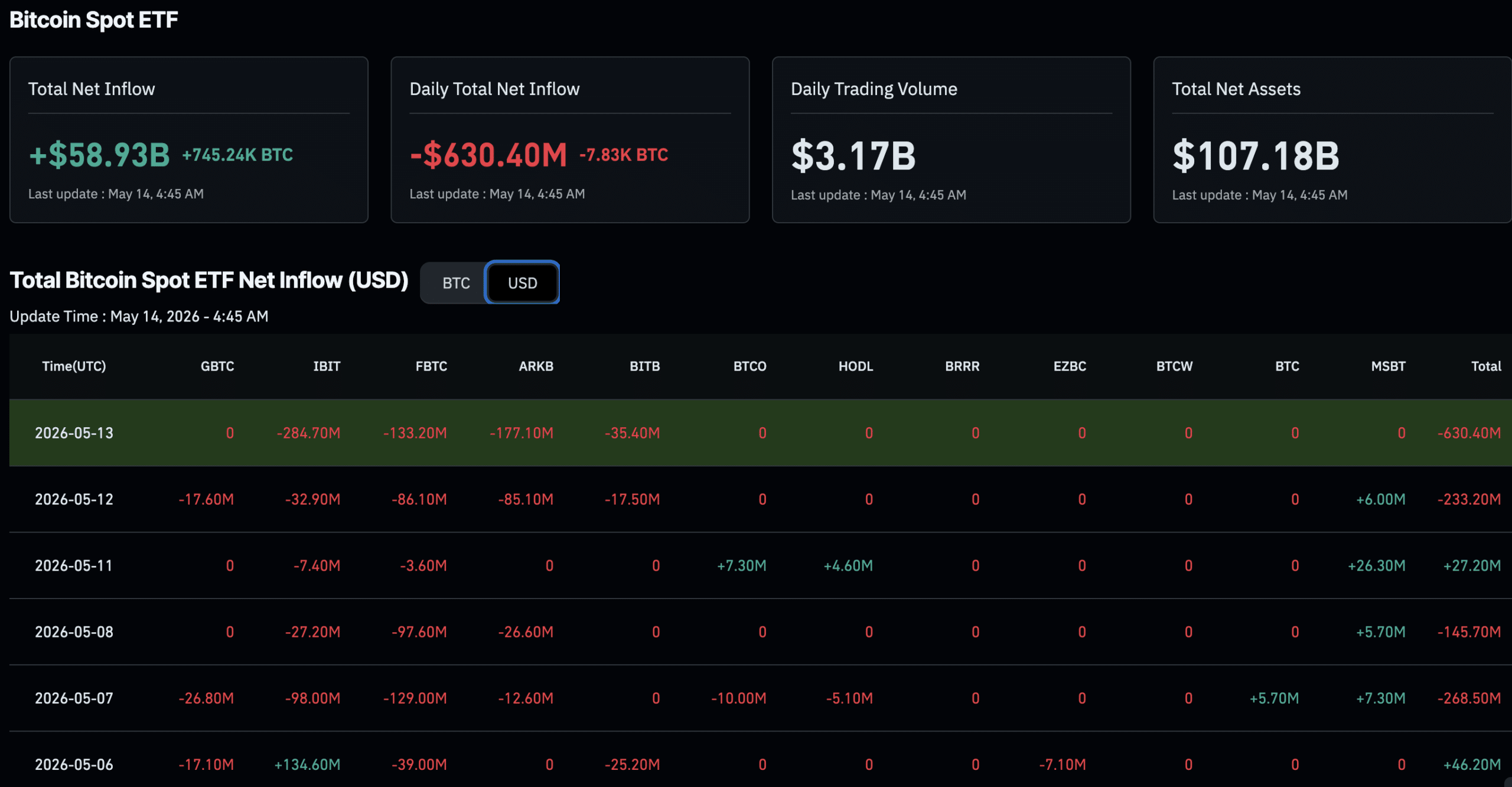
Spot Bitcoin ETFs saw $630M in net outflows on Wednesday alone, the largest single-day withdrawal since late January, bringing the five-session total to approximately $1.26Bn. That scale of institutional redemption, running concurrently with a macro tape that is actively hostile to risk assets, is the context framing every support level discussed below.
BTC USD Price Drops to $79,200 on Xi’s Taiwan Warning
The transmission mechanism is influenced by sovereign risk appetite rather than specific crypto flows. Xi’s warning of potential “collisions” over Taiwan was announced by state media ahead of a bilateral meeting, unsettling Asian equity markets. MSCI’s Asia Pacific index reversed a 0.8% gain to close down 0.1%, while mainland Chinese shares fell 1.3% after reaching their highest level since 2021.
This equity volatility impacted crypto, which has maintained a high correlation with risk assets lately. Bitcoin has struggled to hold its 200-day moving average near $82,000, and past breakdowns suggest this level influences sentiment rather than serving solely as technical support.
Inflation data worsened conditions, with the producer price index exceeding forecasts at 1.4% month-over-month, following Tuesday’s 3.8% CPI reading, the highest in nearly three years. These inflation surprises weaken the structural case for buyers, as noted by Kirill Kretov of CoinPanel, who commented on the politically charged environment where headlines quickly shift sentiment.
Meanwhile, Nasdaq 100 futures rose 0.2%, and Asian tech shares increased by 2.3%, buoyed by Cisco’s 20% after-hours surge. However, the divergence between tech equity strength and crypto weakness highlights that the current BTC USD price struggles are rooted in macro and geopolitical factors, rather than a general shift away from growth assets.
Can Bitcoin Hold $78,000 After Breaking the $80,000 Floor?
$BTC Update
Bitcoin is currently sitting at a very important support area after losing the short-term rising trendline. Right now, price is trying to hold the 79.4K zone, but the structure is starting to weaken as BTC struggles to reclaim higher levels.
The recent move below… pic.twitter.com/nQoCyM2LZx
— Cryptorphic (@Cryptorphic1) May 14, 2026
Bitcoin’s price heading into Thursday’s Asian session is facing challenges, trading around $79,200 after falling below $80,000. The 200-day moving average is near $82,000, a level Bitcoin has struggled to reclaim.
Immediate support is found at $78,000, the early-May low, with further support in the late-April capitulation zone. The RSI indicates room for further downside, while the MACD shows increasing selling pressure.
A significant $635M ETF outflow complicates the situation, making it harder to maintain support levels. Successfully closing above $79,000 would support bullish sentiment ahead of the Trump-Xi talks and macro data releases.
Bull case: A less confrontational joint statement on Taiwan boosts risk appetite, helping Bitcoin reclaim $80,000 and target $85,000.
Base case: The BTC USD price trades between $78,000 and $80,000 as the market awaits developments on geopolitical and inflation issues.
Bear case: Hawkish summit headlines or higher-than-expected inflation could push the price above $80,000, leading to a retest of the $81,500–$83,000 range.
Solana at $90: Leading Losses but Fundamentals Hold
Solana dropped -4% to $90.5, the steepest decline among major assets in the cohort and a move that gave back most of the weekly gains that had made SOL the standout altcoin over the prior two weeks.
Recent analysis of Solana’s price structure identified the $90–$92 zone as a critical demand area; trading into that range on elevated volume is the short-term test the network now faces.
The divergence between price and on-chain activity is notable. Network fees surged approximately 81% over the past week to roughly $4.2M daily, with transaction volume running near $45M per day, metrics driven by sustained memecoin activity on platforms like Pump.fun.
$SOL has formed a nice falling wedge pattern which is a bullish reversal pattern pic.twitter.com/iBUE0RfZC2
— Don 🐂 (@DonWedge) May 14, 2026
That fundamental strength does not prevent price from following Bitcoin lower in a risk-off macro environment, but it does suggest the selling is externally driven rather than a reflection of deteriorating network health.
Immediate resistance for SOL sits near $94–$95, where the asset was trading before the session’s decline. A recovery above that level would suggest the move was a macro flush rather than a trend reversal. Failure to hold $88 on a closing basis would indicate the correction has further to run, with the next meaningful support near $84.
The remainder of the Trump-Xi summit, and whatever joint language emerges on Taiwan and trade, will likely determine whether Thursday’s Asian session marks a bottom or the beginning of a deeper correction across both Bitcoin and altcoins.
Traders should also note that CME Bitcoin derivatives expiry on Friday may generate short-term volatility in the $78,000–$80,000 range regardless of macro direction.
next
Disclaimer: Coinspeaker is committed to providing unbiased and transparent reporting. This article aims to deliver accurate and timely information but should not be taken as financial or investment advice. Since market conditions can change rapidly, we encourage you to verify information on your own and consult with a professional before making any decisions based on this content.

Daniel Frances is a technical writer and Web3 educator specializing in macroeconomics and DeFi mechanics. A crypto native since 2017, Daniel leverages his background in on-chain analytics to author evidence-based reports and deep-dive guides. He holds certifications from The Blockchain Council, and is dedicated to providing “information gain” that cuts through market hype to find real-world blockchain utility.