





Australian tech firm Apate deploys a vast array of AI-bot characters worldwide that play the role of gullible scam victims to waste millions of hours of con artists’ time each month.
Hilariously, one of the company’s monthly performance metrics is how many times frustrated scammers swear at the idiot ‘victims’ who are playing dumb and stringing them along.
“I think we’re the only company in the world that is actually keeping as part of their KPIs the number of F-words that scammers are dropping at them,” Apate founder Dali Kaafar tells Magazine with a chuckle.
The company has a stable of almost 200,000 AI characters that are able to hold convincing phone conversations and to chat on social media and messaging platforms.
”I can tell you that we’re basically servicing, as we call them, hundreds of thousands of calls a day, and pretty much hundreds of thousands of conversations on the other channels,” he says.
Every hour of a con artist’s time they waste is another hour they’re not scamming a member of the public. In the six weeks up to the end of 2025, Apate’s bots engaged in 600,000 scam calls for a single telco called TPG in Australia.
“Essentially, we wasted more than five hundred days of scammers’ time,” he explains. “That roughly equates to somewhere around thirteen million dollars being saved.”
The bots’ other goal is to elicit actionable intelligence for banks and telcos to combat scam rings across Australia, Asia, Africa and the UK and Europe.
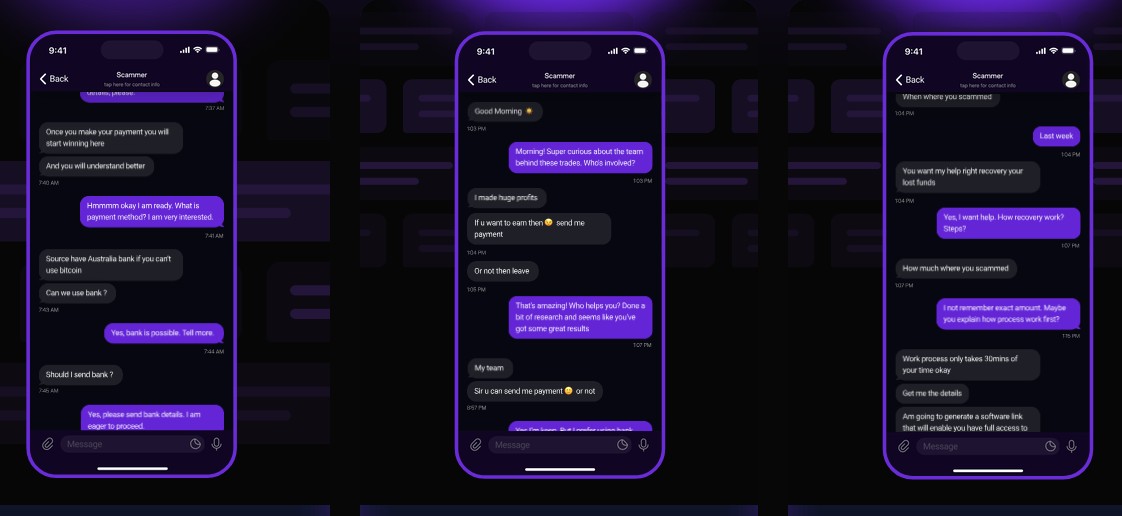
Apate bots deal with scammers via chat. Source: Apate
Scam baiting at scale with AI victims
Kaafar says he got the idea when he received a scam call while having a picnic with his family in Sydney back in November 2021.
To his wife’s annoyance, but his kids’ delight, he strung the scammer along for 44 minutes by pretending to be a gullible rube falling for the scam.
“What followed was really literally a full comedy show for my kids,” he says, adding that during the call he’d also learned a lot of potentially useful information about the mechanics of the scam and the tactics used.
“As I hung up that call, I remember thinking very clearly: if I could do that just for fun, imagine what technology can do at scale.”
Working as a professor at Macquarie University at the time, he raised the idea with some of his doctoral students working on AI and security.
“I said, ‘Guys, there has to be a much better way of doing this. Let’s build something that is really automating this whole process of engaging scammers at scale, but also, perhaps most importantly, extracting all sorts of intelligence from these conversations.’ And that’s literally how it started.”
Related: AI-powered bot stands in for absent candidate in Virginia debate
Within a few months they’d secured funding from the Office of National Intelligence to research the idea, and the project was spun off from the university into Apate in 2023. The company now works with most of the big banks in Australia, as well as numerous banks in the UK, South Africa and South East Asia.
Apate is far from the only company scam baiting fraudsters using AI bots — though they are doing it on a greater scale than most. United Kingdom telco O2 rolled out an AI Granny campaign last year, which frustrates scammers by taking up hours of their time talking about her 28 cats. It was as much an ad campaign to warn the public about the dangers of scam calls as anything else.

O2’s highly entertaining AI Granny. Source: 02
Creating the perfect AI victims
Apate launched with 120 different personas across different genders, ages and personality types, and now have 197,000 personas with identifiable vocal tics, accents, and they make the same noises people make when they’re trying to think of what to say.
“We spent a lot of time refining and building these AI bots that sound exactly like you and I and our neighbors,” he says.
The AI models were trained on “hundreds and hundreds” of hours of recorded conversations between human scam baiters and scammers, so they can employ counter strategies.
“They know that they’re talking to bad guys, if you like, and they really navigate the conversations so that it sounds really very, very realistic to any scammer out there, even if a scammer is skeptical about things.”
The bots get sent out on WhatsApp and Telegram to act as honeypots for scammers. While the old cliché that you can’t scam an honest man is not true, it’s still very possible to exploit the scammer’s desire for money.
“They are cybercriminals, really. I think we just very often forget that they’re cybercriminals who are trying to get people’s life savings. And so that element of greed is sometimes what our bots also exploit.”
Bots collect valuable intel from each scam call
In the crypto industry, Apate works for “one of the leaders in blockchain analysis,” which may or may not be Chainalysis. They aren’t interested in wasting scammers’ time — they want intelligence on which wallets and methods scammers are using so they can track the flow of funds.
“These bots, as they engage across different conversations, extract new crypto wallet addresses by the hundreds and by the thousands,” he says. “It’s data and intelligence that is coming literally before their damage happens.”
Scamming is big business, and the call centers are “pretty much corporate organizations,” Kaafar explains.
“This data is very, very important because, literally, that’s the new account or the new wallet where you really need to pay extreme attention to. Because this is where these… scammer compounds are collecting their money or their funds with.”
“Think about it literally as being always ahead of the scammer’s tactics. And the more you know before the money gets transferred, the better it is.”
In July, Apate’s bots uncovered a marketplace for brokers soliciting verified bank accounts in India, offering commissions of up to 5% paid in USDT on the proceeds from scams passing through the accounts.

Apate’s human staff in Sydney. Source: Apate
AI arms race between good guys and bad guys
Scammers are increasingly using AI bots themselves, and it won’t be too long before AI scammers are as ubiquitous as spam emails. Scamming people is a $1.24 trillion business, so the industry can afford the compute required to scale up operations.
Apate’s research suggests that about 20% to 30% of scam text conversations employ AI already, but Kaafar isn’t too worried about the outcome of anti-scam bots fighting scam bots.
He says their researchers believe that AI bots playing defense have an advantage, according to game theory, because they’re trying to extract intelligence, while the scam bots are trying to get the other AI to perform an action.
“You can also demonstrate mathematically that that is to the advantage of a defender because it becomes easier to extract intelligence from the attacker’s AI model,” he says.
“We can imagine a world where scammers become a lot more sophisticated and deploy such technology. But that also means that if they do, they’re actually deemed to lose the game, which is great news in the fight against scams.”
Magazine: Agent wastes 14 hours of scammers’ time, LLMs ‘poisoned’ by Iran — AI Eye
Cointelegraph publishes long-form journalism, analysis and narrative reporting produced by Cointelegraph’s in-house editorial team with subject-matter expertise. All articles are edited and reviewed by Cointelegraph editors in line with our editorial standards. Some articles contain affiliate links, from which Cointelegraph may earn a commission. These relationships do not influence which products we review or our editorial conclusions. Content published in here does not constitute financial, legal or investment advice. Readers should conduct their own research and consult qualified professionals where appropriate. Cointelegraph maintains full editorial independence.