



Sonic Labs published a supply statement shortly after 22:00 UTC on November 20 that puts the S token count at 4,701,361,519. The number is not an estimate. It is read from totalSupply() on the Sonic Fee Contract at Sonic block 82,118,136, and every component behind it is listed with the block at which a reader can check it.
The figure Sonic described when the network launched in December 2024 was 3.175 billion, a number the company said matched FTM’s maximum supply. The gap is 1,526,361,519 tokens, or 48.07% more supply than that launch disclosure implied. The S Supply Statement attributes almost all of it to a 2019 mint on Fantom Opera that was never matched by a lock or a burn on Ethereum, and it sets out a remediation schedule that is partly dated and partly still open.
What the Statement Reads Off the Contract
The statement is addressed to the contract rather than to a market narrative. Total supply and total stake are both read at block 82,118,136 on the Sonic Fee Contract, at address 0xfc00face00000000000000000000000000000000. Staked S totals 1,196,927,221, or 25.46% of supply on the same reading. Validator rewards are sourced separately, from baseRewardPerSecond on the ConstantsManager contract, which works out to 191,965 S a day at a fixed schedule of 70,067,224 S a year.
The supply itself is broken into seven components, and they sum exactly to the reported total.
| S supply component | Millions of S |
|---|---|
| Genesis allocation | 50.0 |
| Converted from Fantom Opera | 2,630.7 |
| Converted from Ethereum | 1,330.8 |
| Validator rewards claimed since launch | 108.9 |
| Airdrop and business development | 513.5 |
| Bridge liquidity | 59.9 |
| Burns made outside the SFC, still counted in supply | 7.6 |
| Total supply on-chain | 4,701.4 |
Source: Sonic Labs, S Supply Statement, November 2026. The original marks its components as rounded.
Two of those lines carry 84.2% of the total between them. Conversion from the two FTM chains produced 3,961.5 million S at a 1:1 rate, which is already 786.5 million more than the entire supply Sonic described at launch. Mints issued for the airdrop and business development added 513.5 million, the last of them in October 2025. The remaining 226.4 million is the sum of genesis, claimed validator rewards, bridge liquidity and the 7.6 million S that the statement says was burned outside the SFC but is still being counted until that accounting is fixed.
The 2019 Mint That Never Got Its Offset
The statement’s account of the origin is specific. When Fantom Opera launched in December 2019, 2.12 billion native FTM were minted. To keep supply from diluting, an equivalent amount of ERC-20 FTM should then have been locked on Ethereum or burned permanently. Sonic’s initial audit found approximately 647 million ERC-20 FTM sitting in a Timelock on Ethereum. That leaves roughly 1.47 billion ERC-20 FTM that was never locked and remained eligible for conversion at 1:1 alongside the native tokens.
“Based on the findings of our token supply audit, the historical FTM supply discrepancy is a key factor behind the current level of Sonic’s token supply,” the statement reads. The arithmetic behind that sentence is direct. The unlocked balance is 31.3% of today’s supply and 96.5% of the 1.53 billion gap between the launch figure and the on-chain total, which is why the statement treats the 2019 step as the origin rather than a contributing factor.
What the statement does not do is describe the result as a windfall. It treats the two chains as separate supplies that were both accepted for conversion, and it publishes the outstanding balances rather than netting them away. Roughly 807 million FTM remains on Ethereum, of which 160 million sits with holders and 647 million in the Timelock, and 268 million FTM remains on Opera with holders. That is 428 million FTM still convertible, equal to about 9.1% of current S supply, against a bridge that has been open for nearly two years.
Two Chains, One Conversion Rate, and a 5.04 Billion FTM Denominator
The statement’s own figures reconcile to the last decimal, which is the part worth checking first. Ethereum FTM has a max total supply of 2,138 million. Of that, 1,331 million is locked in the Sonic gateway and 807 million is still outstanding, and the two add to 2,138 million exactly. On Opera, 2,898 million FTM is accounted for as 2,631 million converted plus 268 million still with holders. Across both chains the denominator is 5,036 million FTM, and 3,961.5 million of it has already become S, 428 million can still convert and 647 million sits in the Timelock. Those three figures add to 5,036.5 million, inside the rounding the statement declares.
That reconciliation matters because it moves the argument away from intent. The supply is fully accounted for in the sense Sonic claims: every S traces to a conversion, a mint or a reward claim. What the 2019 step changed was the denominator. A supply of 3.175 billion assumed one chain’s worth of FTM. The conversion accepted two, and the Ethereum side was never reduced by the lock the design called for. The mechanics of that handover are the same ones we traced in the FTM to S conversion and what happened to the old Fantom token.
An illustrative subtraction shows how much of the gap sits there. Take the 1.47 billion unlocked ERC-20 FTM out of today’s total and supply would stand at 3,228,361,519 S, or 1.68% above the launch figure rather than 48.07% above it. That is arithmetic on the statement’s numbers, not a claim about what would have happened, but it locates the discrepancy in a single balance rather than across five years of issuance.
The Commitments, and Which Ones Carry a Date
The remediation is a list of steps at different stages, and the difference between a promise and a date is the part holders can act on.
| Step | Status in the statement |
|---|---|
| Remove the manual mint function from the SFC | Contract update, no ship date given |
| Burn 91.7 million S from the airdrop allocation | 15 December 2026 |
| Burn roughly 1,331 million FTM locked in the Ethereum bridge | 31 January 2027; does not change S supply |
| Close the Ethereum and Fantom conversion bridges | Date to be confirmed, announced in advance |
| Fix the accounting for burns made outside the SFC | In progress |
| Publish the final reconciliation of the 2019 FTM issuance | Pending, after the audit completes |
Only two of those carry a date. The contract change that would end manual minting has none, though the last manual mint is documented at block 52,250,742 on 28 October 2025. The bridge closure, which determines how long the 428 million FTM can still become S, is also undated. “We will announce a final conversion deadline in advance so holders have time to convert,” the statement says, which sets an obligation to warn without fixing when the warning arrives.
The January burn deserves a precise reading because it is easy to misstate. Burning 1,331 million FTM locked in the Ethereum bridge removes FTM, not S. The matching S was issued when that FTM was converted, so the burn reduces the unconverted FTM side of the ledger without changing the 4.70 billion S figure. The December burn is the one that moves S supply, by 91.7 million, or 1.95% of the current total.
What the Statement Does Not Establish
The document is candid about its own limits, and they are worth separating from the parts that are settled. The review was commissioned by Sonic and carried out by Ledgity, so it establishes what the contract holds and what the historical balances were. It is not a finding about how the missing lock came about. “The objective of this ongoing audit is to fully reconcile the historical FTM issuance and establish how the discrepancy arose,” the statement says, and adds that the findings will be published when that work is complete. Until then, the cause is an open question the company has committed to answer, not a conclusion the document delivers.
Two smaller points sit in the same category. The 7.6 million S burned outside the SFC is still counted in total supply, which the statement acknowledges as a defect it is fixing, so the reported figure overstates circulating burn-adjusted supply by that amount. And the statement’s net issuance figure of approximately 1.48% a year sits slightly below the 1.49% that the 70,067,224 S fixed reward schedule implies against a 4.70 billion base. The difference implies fee burns of roughly 487,000 S a year, while the statement says about 2.0 million S has been burned to date. Rounded components can explain part of that, and the statement invites holders to write to a feedback address if something does not add up, which is the correct route for a discrepancy of that size rather than a conclusion drawn from it.
A 48% Larger Denominator in a Falling Market
Supply accounting and price are separate questions, and the statement does not attempt to connect them. The market has moved on its own schedule. S traded at $0.025972 at 08:53 UTC on November 21, down 11.0% over 24 hours, 28.8% over seven days and 51.2% over 30 days, per CoinGecko. It sits 97.5% below its January 2025 high of $1.029.
The same session was not specific to Sonic. Bitcoin traded at $57,939, down 6.3%, and Ether at $1,630, down 6.9% at the same timestamp. An 11% decline in a day when the two largest assets fell 6% to 7% is consistent with a broader risk-off move rather than a reaction to a supply document, and the timing alone does not establish that the statement pressured the token. What the document changes is the denominator anyone is pricing against.
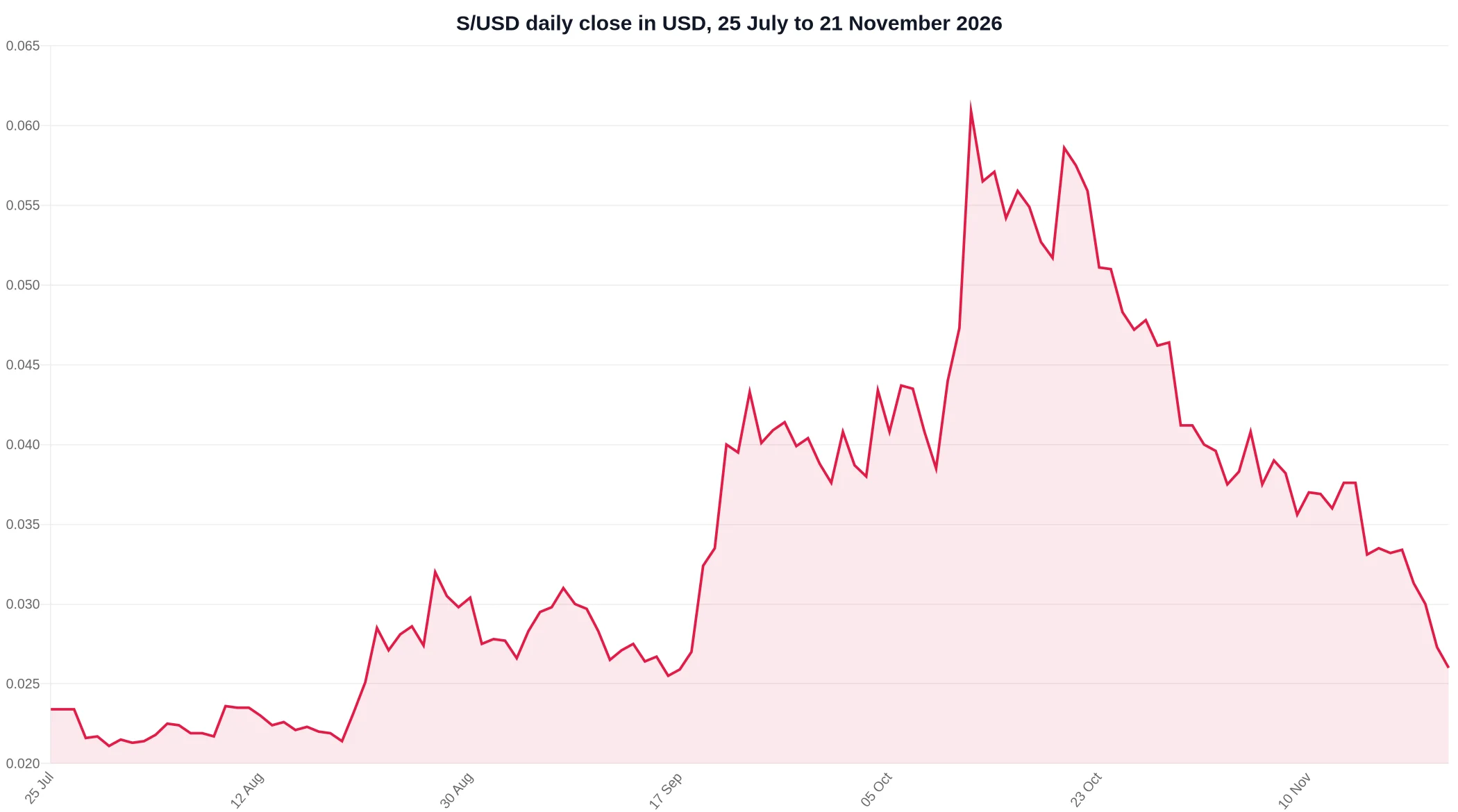
Fully diluted value at the 08:53 price is $122.1 million on 4.70 billion tokens, against $82.5 million on the 3.175 billion figure Sonic used at launch, a difference of $39.6 million at an unchanged price. The 428 million FTM still convertible is a second layer: if all of it converted, supply would rise 9.1% before the December burn and 7.15% net of it, to roughly 5.04 billion. Circulating supply of 4.38 billion is already 93.1% of the total, so the usual unlock overhang is small and the dilution question sits almost entirely on the bridge side. That differs from the pattern we described in how rising token supply pressures prices when absorption lags, where new supply arrived against thin demand rather than from a conversion ledger.
For anyone holding S through the transition, the practical answer is narrower than the headline. The supply figure will not be revised downward by any large amount: the two burns remove 1.95% of S and a quantity of FTM that no longer maps to S. The number that can still rise is the 428 million FTM, and the date that matters is the bridge deadline Sonic has promised to announce but has not yet set.
Frequently Asked Questions
How many S tokens are in circulation?
The Sonic statement puts total supply at 4,701,361,519 S at Sonic block 82,118,136. CoinGecko reported circulating supply of about 4.38 billion S at 08:53 UTC on November 21, which is 93.1% of the total.
Why is S supply 48% higher than the announced figure?
Sonic says the launch figure of 3.175 billion matched FTM’s maximum supply on one chain. Conversion was opened to FTM on both Ethereum and Fantom Opera at 1:1, and a 2019 mint of 2.12 billion native FTM was never matched by locking the equivalent ERC-20 tokens. About 1.47 billion ERC-20 FTM stayed unlocked and convertible.
Will the December 15 burn reduce S supply?
Yes. Sonic has committed to burning 91.7 million S from the airdrop allocation on 15 December 2026, which is 1.95% of current supply. The 31 January 2027 burn of roughly 1,331 million FTM does not change S supply, because the matching S was issued when that FTM converted.
Can new S still be created outside validator rewards?
Under the current contract, manual minting still exists but has not been used since 28 October 2025, at block 52,250,742. Sonic says it is updating the SFC to remove the manual mint function, after which validator rewards at 70,067,224 S a year would be the only source of new S.
How much FTM can still be converted to S?
About 428 million FTM: 160 million held on Ethereum, 268 million held on Opera. A further 647 million FTM sits in an Ethereum Timelock. The bridges have been open for nearly two years and Sonic has said it will announce a final conversion deadline in advance.
The full supply breakdown, with the block heights for each figure, is published in the two-page audit statement. The FTM token contract referenced in it can be read on Etherscan.
Disclosure: This article does not represent investment advice. The content and materials featured on this page are for educational purposes only.
About the author
Jide Idowu is a skilled freelance writer with expertise in blockchain technology, cryptocurrency, and digital finance. Known for his ability to break down complex topics into clear, engaging content, Jide crafts articles, blog posts, and analyses that resonate with both beginners and seasoned professionals. His work spans a wide range of subjects, from emerging crypto trends to in-depth explorations of blockchain innovations. With a keen eye for detail and a passion for educating readers, Jide is a reliable voice in the rapidly evolving world of digital assets.
View all articles by Jide Idowu